
How Far in Advance Should You Book a Contractor?
You finally decide it is time to build the deck, remodel the kitchen, finish the basement, or tackle another project that has been sitting on the wish list for years. You start thinking about materials, saving inspiration photos, and imagining what the finished space will look like.
Then you call a contractor and hear something you were not expecting: “Our next available opening is a few months from now.”
Is that normal? Should you have called earlier?
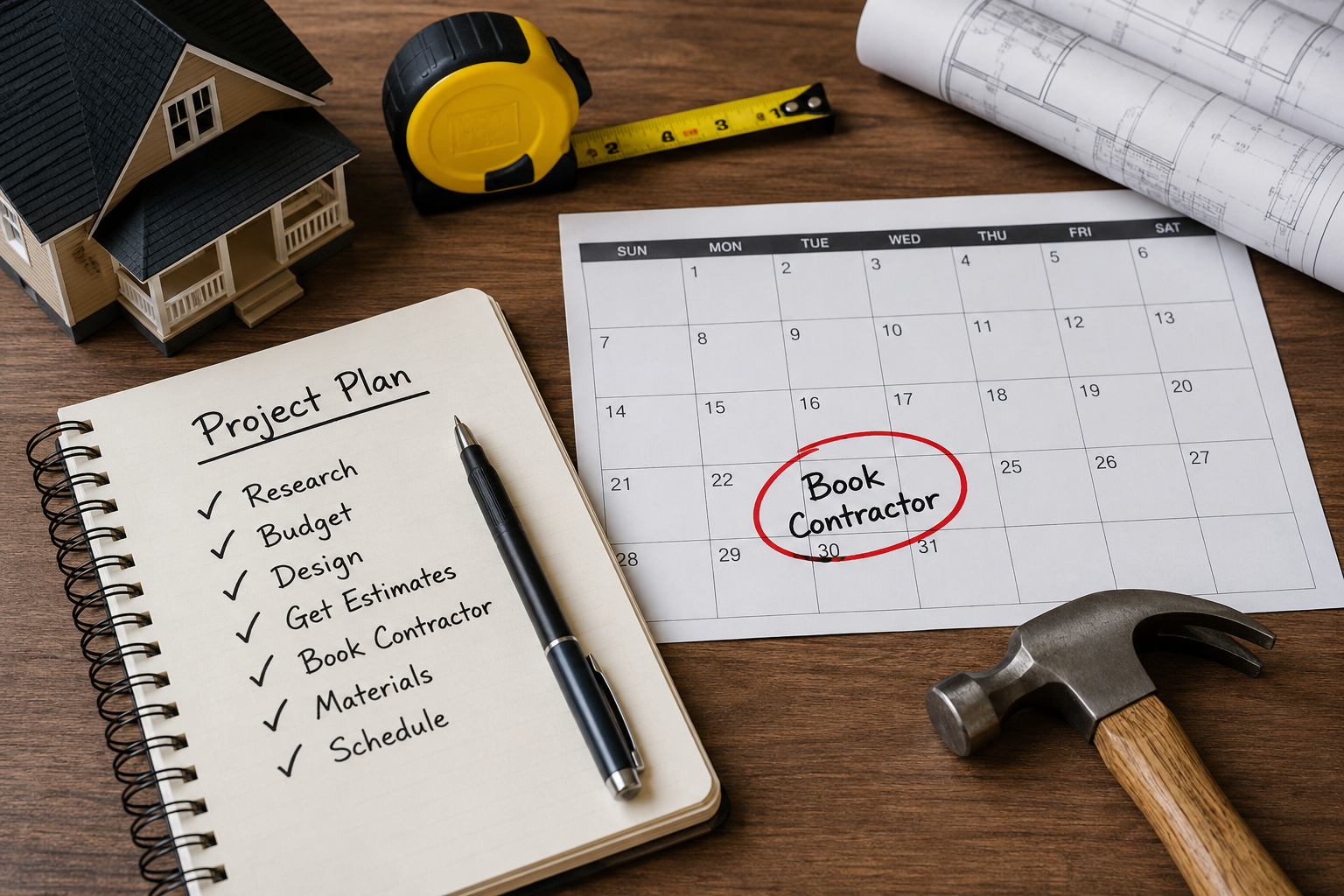
In many cases, homeowners should begin contacting contractors several months before they hope construction will begin, especially for larger remodeling projects. However, there is no universal rule. Contractor availability can range from a few days or weeks to several months depending on the type of project, time of year, crew size, current workload, material availability, permits, and many other factors.
That does not mean a contractor with immediate availability should automatically be viewed negatively, nor does a long waiting list automatically indicate higher-quality work. Availability is simply one piece of a much larger picture.
Understanding how contractor scheduling works can help homeowners plan ahead without feeling pressured to hire someone before they are ready.
Why Contractor Availability Can Vary So Much
Two contractors who perform similar work in the same area can have completely different schedules.
One may be able to begin next month while another is scheduling projects four months ahead. Both situations can be completely reasonable.
Contractors operate businesses of different sizes and structures. A small carpentry company with one crew, for example, can only complete a certain number of projects at once. A larger remodeling company might have several crews working simultaneously.
The projects already on the calendar matter, too.
Imagine two contractors each have three projects scheduled. Contractor A has three small projects expected to take four days each. Contractor B has three major remodeling projects expected to take six weeks each. Although they technically have the same number of clients waiting, their next available dates will be very different.
Cancellations and schedule changes can also suddenly create openings. A project may be postponed because a homeowner's financing changes, materials are delayed, or another personal circumstance arises.
For that reason, contractor availability should not be used by itself to judge the quality or reputation of a company.
Instead, homeowners should consider the entire picture: experience, communication, references, project fit, professionalism, workmanship, insurance, contract details, and whether they feel comfortable working with the contractor.
Typical Contractor Wait Times by Type of Home Improvement Project
When homeowners ask, “How far in advance should I book a contractor?”, the type of project is one of the biggest factors.
A small repair and a full kitchen remodel require very different amounts of planning.
Small Carpentry and Home Repair Projects
Smaller projects can sometimes fit into a contractor's schedule more quickly.
These might include replacing a door, repairing stairs, completing trim work, replacing a few damaged boards, or handling other relatively contained carpentry projects.
However, small does not always mean immediate.
A carpenter may have an opening between larger projects, or the company may group smaller jobs together. In other cases, the crew may already be committed to larger projects for several weeks.
If the project is not urgent, contacting a contractor at least several weeks ahead gives you more flexibility.
Deck and Porch Projects
Decks and porches require more planning than many homeowners initially expect.
There may be decisions about decking, framing, railings, stairs, lighting, skirting, footings, permits, and layout. Composite decking and railing systems can also have specific ordering requirements.
Seasonality matters significantly.
Many homeowners start thinking about their deck when the weather becomes warm enough to use it. Unfortunately, that is also when many other homeowners have the same idea.
If you want a deck ready for summer, starting conversations with contractors during the colder months or early spring can give you significantly more flexibility.
Think of it like booking a popular vacation destination. Waiting until the week before a holiday does not necessarily mean there will be no rooms available, but you will probably have more options if you plan earlier.
Kitchen Remodeling
Kitchen remodels often require considerably more coordination.
Cabinets may need to be designed and ordered. Countertops can require measurements after cabinets are installed. Plumbing and electrical work may need to be coordinated. Appliances, flooring, tile, and fixtures all have their own ordering and installation timelines.
That means the contractor's construction calendar is only part of the equation.
Suppose you want construction to begin in June. Calling contractors for the first time in late May may make that difficult, even if a contractor has an opening. The cabinets or other materials needed for the project might not be ready.
For a significant kitchen remodel, beginning the contractor search several months before your preferred construction date is a much safer approach.
Basement Remodeling
Basement projects can range from relatively straightforward finishing projects to major renovations involving bathrooms, bedrooms, entertainment areas, electrical work, plumbing, egress windows, and substantial layout changes.
The more trades involved, the more scheduling becomes a puzzle.
A basement requiring framing, electrical, plumbing, drywall, flooring, painting, and finish carpentry does not simply need an available carpenter. Each stage has to happen in the correct order.
For larger basement projects, homeowners should generally begin conversations with contractors months rather than weeks ahead.
Whole-Home and Large Remodeling Projects
Major renovations require the longest planning periods.
Structural changes, engineering, design decisions, permits, custom materials, subcontractors, and multiple phases of construction can all be involved.
If you are planning a large remodel around an important deadline—such as moving into the house, having a baby, hosting a major family event, or selling the property—bring that date up during the first conversations with potential contractors.
Do not assume that a desired start date and desired completion date are interchangeable.
A project starting in September might not be finished in September.
Why Some Contractors Are Booked Months in Advance
It can be surprising to hear that a contractor is scheduling several months ahead, but there are practical reasons this happens.
Construction businesses have limited labor. A contractor cannot simply add another major project to Tuesday afternoon in the same way another business might add a meeting to the calendar.
If a crew is remodeling a kitchen, that crew may be committed to the project for weeks.
Good scheduling also requires some breathing room because construction is not perfectly predictable.
A contractor might open a wall and discover damaged framing. Weather could stop exterior work. An inspection may need to be rescheduled. A special-order material might arrive late.
Contractors therefore have to balance keeping crews productive with avoiding unrealistic promises to homeowners.
Seasonal demand also plays a major role. Decks, porches, exterior carpentry, and similar projects often receive increased interest during warmer months.
The important takeaway is simple: a long lead time often reflects the realities of the contractor's current schedule, not a rule about how construction businesses are supposed to operate.
Does a Long Wait Time Mean a Contractor Is Better?
No.
A contractor being booked for several months can certainly indicate strong demand, but it should never be treated as proof of quality.
There are excellent contractors with long waiting lists and excellent contractors with openings available sooner.
For example, a contractor might have an unexpected opening because a large project was postponed. Another company may have recently hired an additional skilled carpenter and increased its capacity. A larger contractor may simply be able to handle more simultaneous projects.
Conversely, being booked six months ahead does not guarantee that a contractor is the right choice for your project.
Homeowners should look deeper.
Review previous work. Ask questions about similar projects. Understand what is included in the estimate. Pay attention to communication. Read the contract carefully. Make sure expectations around materials, payment, scheduling, and changes are clear.
Availability tells you when a contractor can work. It does not tell you how well that contractor will work.
Does Immediate Contractor Availability Have to Be a Red Flag?
Absolutely not.
Homeowners sometimes hear advice such as, “Never hire a contractor who can start immediately.”
That is far too simplistic.
There are many perfectly reasonable reasons a qualified contractor could have near-term availability.
A project may have been postponed. Weather may have changed the schedule. A contractor may intentionally reserve openings for smaller projects. The company might have expanded its crew. You might simply happen to call at the right time.
Instead of treating availability itself as suspicious, ask practical questions.
What does the project process look like? Has the contractor completed similar work? Is there a clear written scope? What materials will be used? How are changes handled? Who will be performing the work?
Those answers are much more useful than trying to determine quality from the calendar alone.
How the Time of Year Affects Contractor Availability
Contractor schedules often change with the seasons.
Exterior projects typically receive more inquiries when the weather warms up. Homeowners start spending time outside and suddenly notice the deck boards that need replacement, the porch they want screened in, or the outdoor living area they have been thinking about.
Interior remodeling can have its own busy periods as well.
This creates an important planning lesson: the best time to contact a contractor is often before everyone else starts thinking about the same project.
If you want an outdoor project completed for summer, do not necessarily wait until the first beautiful weekend of summer to begin researching contractors.
Similarly, if you want a kitchen finished before a major holiday, beginning the process in late fall may leave very little room for design decisions, ordering, construction, and unexpected delays.
Planning early does not mean construction needs to begin immediately. It simply gives you time to make better decisions.
Why You Should Contact Contractors Before Your Plans Are Finalized
Some homeowners wait to contact a contractor because they believe every detail needs to be decided first.
Usually, that is unnecessary.
You should have a reasonable idea of what you want, but an early conversation with an experienced contractor can actually help shape the project.
Suppose you are planning a new deck and have already decided on an exact size, staircase location, railing style, and layout. During the walkthrough, the carpenter notices that shifting the staircase could improve traffic flow and make better use of the yard.
That is valuable information to receive before everything has been finalized.
The same applies indoors.
You may know that you want a larger kitchen without knowing exactly where every cabinet should go. You might want a finished basement without having selected flooring. You may know that your porch needs to be rebuilt without knowing which railing system makes the most sense.
Starting the conversation early allows the contractor to identify practical considerations while changes are still easy to make.
How Material Lead Times Can Affect Your Project Start Date
Booking a contractor is only one part of scheduling a construction project.
Materials need to arrive, too.
Common products such as standard lumber may be readily available, while custom doors, cabinets, specialty railings, windows, countertops, fixtures, or particular finishes can require additional time.
Imagine reserving a restaurant table for 7:00 p.m., but half the ingredients for dinner will not arrive until 8:00 p.m. Having the table ready does not solve the problem.
Construction can work the same way.
A contractor may technically have labor available, but beginning too early without necessary materials can create unnecessary disruption.
This is another reason early planning matters. It provides time to identify products with longer lead times and order them before they become a scheduling problem.
Permits, Inspections, and Subcontractors Can Add Time Before Construction Begins
A contractor's calendar is not always the only calendar involved.
Depending on the project and local requirements, permits may need to be obtained before work begins. Inspections may also be required at different stages.
Projects involving electrical, plumbing, HVAC, drywall, tile, or other specialized work can require subcontractor coordination.
Think of a remodeling schedule like a line of dominoes.
Framing may need to happen before electrical work. Electrical and plumbing may need to be inspected before walls are closed. Drywall needs to be completed before certain finish work can begin.
If one step moves, several steps after it may move as well.
This does not mean homeowners should expect endless delays. It simply means that a realistic remodeling timeline should account for more than the number of days someone is physically using tools inside the house.
What Happens If You Wait Too Long to Book a Contractor?
Waiting does not necessarily mean your project cannot happen.
It does, however, reduce your options.
You may have fewer available contractors for your preferred timeframe. Your first-choice materials might not arrive in time. You may need to adjust the project's completion goal.
The biggest issue occurs when the project is tied to a firm deadline.
Suppose you want a new deck completed before a graduation party in June. If you begin calling contractors in early June, there is very little flexibility.
Now imagine making those calls months earlier.
Even if construction does not begin until later, you have time for walkthroughs, estimates, design changes, material selections, permits, and scheduling.
Early planning creates options.
That is the real advantage.
Can a Contractor Reserve Your Project Before Every Detail Is Decided?
Depending on the contractor and the type of project, it may be possible to reserve a general place on the schedule while some details are still being finalized.
However, every company handles scheduling differently.
Some contractors require a signed contract and deposit before reserving a start window. Others may need major material selections completed first. Large remodeling projects may require a design or preconstruction phase before a construction date can reasonably be established.
Ask specifically what it means when your project is “scheduled.”
Is that an exact start date? An estimated week? A general month? Does the date depend on material arrival or permit approval?
Those distinctions matter.
A clear conversation about scheduling can prevent frustration later.
Questions to Ask About a Contractor's Schedule Before Signing a Contract
Homeowners do not need to interrogate a contractor about every hour of the construction calendar, but they should understand the basic expectations.
Ask about the estimated start window and expected project duration.
Find out whether material availability could change that schedule.
Ask how weather delays or unexpected conditions are handled.
For larger remodeling projects, ask whether subcontractors have already been considered in the timeline.
It is also worth asking how schedule changes will be communicated.
Construction schedules can change. What matters is whether everyone understands the expectations and whether changes are communicated clearly.
How to Plan Backward From the Date You Want Your Project Finished
One of the easiest ways to plan a home improvement project is to stop thinking first about when construction should start.
Instead, identify when you would ideally like it finished.
Then work backward.
Suppose you want a deck completed before a family gathering in July. The deck itself might require several weeks of construction depending on its complexity. Before construction, there may be permitting, material ordering, design decisions, an estimate, a walkthrough, and time spent researching contractors.
Suddenly, a July deadline becomes a conversation that should have started much earlier in the year.
Build extra time into the schedule whenever the completion date is important.
Construction involves existing homes, weather, materials, people, and sometimes conditions that cannot be seen until work begins. A schedule with zero breathing room leaves no space for any of those variables.
What Homeowners Can Do While Waiting for Their Project to Start
Being on a contractor's schedule does not mean nothing happens until construction day.
The waiting period can be extremely useful.
Finalize material choices. Confirm colors and finishes. Review the scope of work. Ask questions about anything you do not understand.
For interior projects, begin thinking about how the construction will affect daily routines. Where will furniture go? Will part of the house be unavailable? Do pets need to be kept away from the work area?
For exterior projects, think about access. Deck construction, for example, may temporarily affect how you use the backyard.
This is also a good time to avoid unnecessary last-minute changes.
Changing a railing color on paper is easy.
Changing it after the railing has been ordered is another story.
Planning Ahead Without Rushing Your Contractor Decision
There is an important difference between starting early and hiring quickly.
Starting early gives you more time to research.
You can talk with contractors, compare scopes of work, look at previous projects, ask questions, consider materials, and determine who is the best fit.
Waiting until you desperately need construction to begin can create the opposite situation.
Suddenly, availability becomes the deciding factor.
That is not ideal.
You should not feel forced to choose Contractor A simply because Contractor B cannot meet an unrealistic deadline you created by starting the search too late.
Planning ahead puts the homeowner back in control.
It allows you to evaluate contractors based on the things that actually matter: communication, workmanship, project experience, professionalism, scope, value, and trust.
The Bottom Line: Start the Contractor Search Earlier Than You Think
So, how far in advance should you book a contractor?
There is no single number that works for every home improvement project.
Small projects may sometimes be scheduled within days or weeks. Decks, porches, kitchens, basements, and other larger projects often benefit from several months of advance planning. Major renovations may require an even longer runway because design, permits, materials, and multiple trades can all affect the schedule.
If you have an important completion date, start even earlier.
Most importantly, do not judge a contractor solely by how soon—or how late—they can begin.
A contractor with several months of work scheduled is not automatically better than one with an opening next week. Likewise, near-term availability is not automatically a warning sign.
Ask questions. Understand the scope. Look at previous work. Discuss the timeline openly.
And when possible, begin the conversation before you feel like you need to.
The worst that happens is you discover you started planning earlier than necessary.
The better outcome is that you have enough time to choose the right contractor, make thoughtful decisions, order the materials you actually want, and build a realistic schedule without rushing one of the biggest investments you may make in your home.